
A phrase on the front of a shirt won't get you a trademark on its own. See how the USPTO reads t-shirt designs and what makes a slogan registrable.
Trademark vs. LLC: What’s the Difference, and Which Do You Need First?
Written by Adrian Torres ·
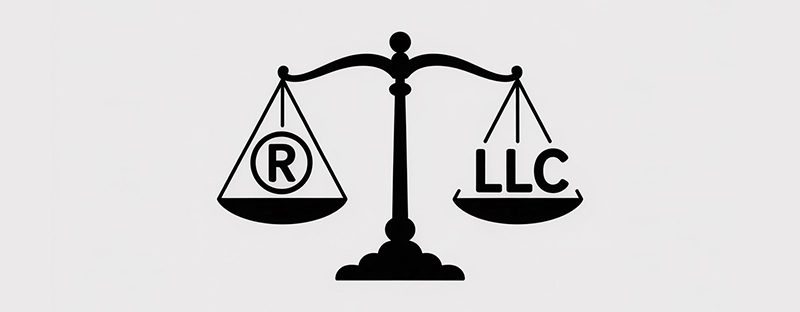
Working up a business idea is hard when you’ve got tons of resources to consult. And even if you manage to hit a winning combination, you can get bogged down in the details of how to actually protect it. By far the two most essential steps to company creation are “registering a company” and “protecting the brand.” This boils down to the differences in trademark vs. LLC, but if you’re new, you might not realize if you need an LLC or trademark first (or at all).
Here’s what you need to know.
What Is Trademark vs. LLC and How Do They Work?
An LLC (Limited Liability Company) is one of the forms of companies that legal entities can take to become registered in the U.S. Other countries typically have legal structures similar to an LLC (for example, the UK uses Ltd for Private Limited Company, while Germany has GmbH). So, if you’re reading this from a place other than the U.S., you can substitute LLC for the analogous structure where the company becomes its own legal entity separate from the owner(s) and thus accrues debts or inventory.
On the other hand, a trademark is a logo, phrase, a collection or combination of colors, or even a font that uniquely describes what your company does or offers in the competitive space within its industry. For example, Coca-Cola has registered multiple trademarks, so companies can’t use its specific font of white letters on its distinctive red background or the red disk-shaped logo.
Notably, filing for a trademark and an LLC are entirely different processes. An LLC needs to be filed with your Secretary of State, and you’ll need to file as a foreign LLC for all states you plan to conduct business in. Trademarking is a federal process run through the U.S. Patent and Trademark Office (USPTO), where the part of the filing directly references territories or states (which typically confers country-wide protection).
In terms of use, LLCs and trademarks ultimately serve different purposes. An LLC is (at its most simple form) a tax and asset designation that delineates the company from you as the owner. Notably, the company name doesn’t even have to do anything with the brand name, and if the LLC is registered within a single state, anyone else can utilize the LLC name in another. It’s the trademark that protects your brand’s image, reputation, and recognition from would-be copycats.
For a simple example, the Coca-Cola Company also owns Sprite and Fanta trademarks and brands.
Do I Need an LLC to Trademark My Brand?
Technically speaking, no. If your long-term plan for the business is to be self-employed, or you don’t have a company registered yet, you can file for a trademark that protects your idea, marketing, or logo.
However, there’s an important distinction here in that trademarks are owned by a single legal entity and are not easily transferable, even between a person and the company they own. If you plan to operate as an LLC, then the LLC needs to be the “filing” legal entity and the owner of the trademark. As such, it’s better to review your strategy and create the right type of legal entity for your business before filing for a trademark under its name.
Should I Register an LLC or Trademark First?
Most legal experts will recommend that you first register an LLC before moving on to the trademark.
Besides the legal implications of trademark ownership mentioned earlier, LLC registration is fairly simple and quick in most states. It also allows you to actually start working on building your brand before you get large enough to need to protect it.
After that, you can file for a trademark using a recognizable part of your identity. This is important because the USPTO can actually reject an application if the trademark is not strong enough, which you won’t be able to contest unless you have the business data behind it.
Finally, a trademark doesn’t actually offer any legal protection for your business in terms of investments or assets; it just prevents inappropriate use by third parties.
Ultimately, You Might Need Both
The trademark vs. LLC debate isn’t really an “either-or” situation but a “which to do first” scenario. If you want to fully protect your business from being copied, you need a trademark. If you need to protect your personal assets from your company’s workings, you need an LLC registration.
Luckily, once you go through the process of LLC creation and have landed on a trademarkable idea, you don’t have to maneuver through trademark law alone. Professional trademark protection services can help you file your application with the USPTO and even global trademark registrars and set up real-time monitoring and alerts so you can detect breaches.